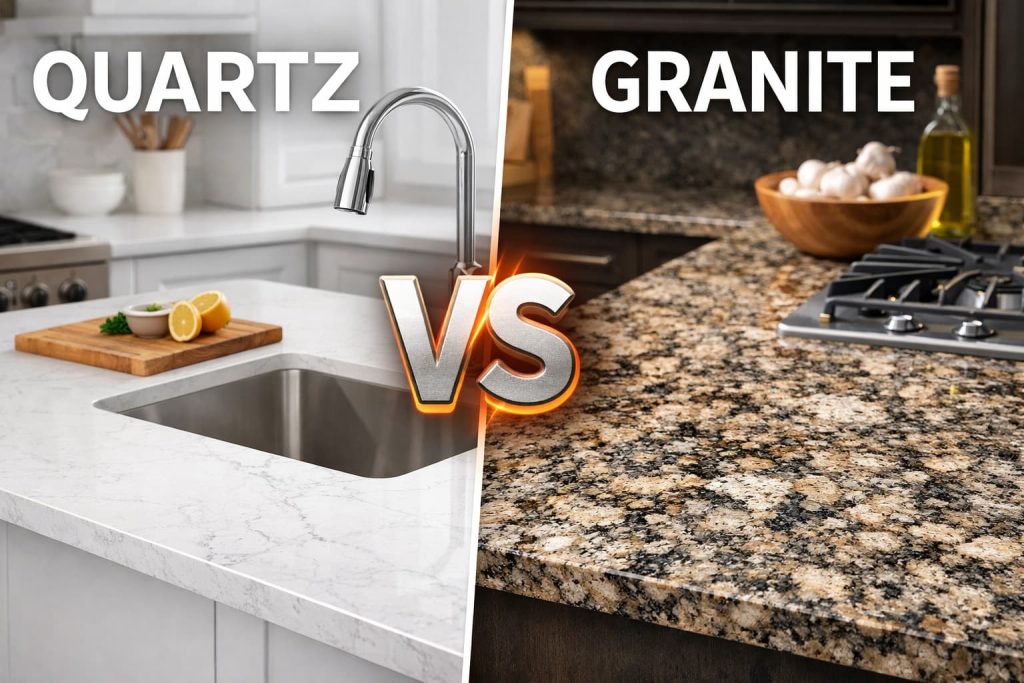
Choosing the perfect countertop is more than just a design decision – it’s about how your space feels, functions, and stands the test of time. As homeowners, we often look for surfaces that are durable, beautiful, and easy to maintain. That’s why the debate between quartz and granite countertops is so common.
At Baba Quartz, we manufacture premium quartz surfaces, so we understand the science, design possibilities, and practicalities better than anyone. In this guide, we’ll break down the key differences, explore pros and cons, answer common questions, and show why quartz is often the top choice for modern kitchens.
What Are Quartz and Granite Countertops?
Before comparing the two, it’s important to understand what they are and how they differ. Both quartz and granite are premium surfaces used in kitchens, bathrooms, and commercial spaces, but their origins, composition, and maintenance needs are very different.
Quartz Countertops
Quartz countertops are engineered surfaces, made by combining crushed natural quartz with resin and pigments. This gives them:
- A non-porous surface, making them resistant to bacteria and stains.
- A uniform, consistent appearance, ideal for modern kitchens.
- An extensive range of colors and patterns, including options that mimic marble, granite, or even concrete.
In short, quartz gives you the beauty of natural stone with the performance and predictability of engineered design.
Granite Countertops
Granite, on the other hand, is 100% natural stone. Each slab is quarried and polished to reveal its unique veining and patterns. Granite:
- Offers one-of-a-kind designs, no two slabs are alike.
- Is naturally heat-resistant and durable.
- Requires periodic sealing, as it is porous and can stain if not properly maintained.
If you love the natural, earthy feel of stone with an organic uniqueness, granite is a strong contender.
Quartz vs Granite: Pros and Cons
Deciding between quartz and granite is often about balancing aesthetics, functionality, and lifestyle needs. Here’s a clear breakdown.
Pros of Quartz Countertops
- Non-porous surface: No bacteria or mold buildup, perfect for busy kitchens.
- Low maintenance: No sealing required; simple cleaning with mild soap and water.
- Durable and strong: Resistant to scratches and chips from everyday use.
- Design versatility: Wide array of colors and patterns, often impossible in natural stone.
- Consistency: Ideal for large kitchen islands or matching multiple surfaces.
Cons of Quartz Countertops
- Quartz is not fully heat-proof, so placing very hot pans directly on the surface can cause damage.
- Extended exposure to direct sunlight may lead to slight color changes, which is why quartz is recommended mainly for indoor spaces.
- As an engineered surface, quartz may not offer the natural variation found in quarried stone like granite.
Pros of Granite Countertops
- Unique patterns that make each countertop truly one-of-a-kind.
- High heat resistance, able to handle hot pots and pans directly.
- Long-lasting durability when properly sealed and maintained.
Cons of Granite Countertops
- Porous surface, requiring periodic sealing to prevent stains.
- Maintenance-intensive, spills must be wiped immediately to avoid etching.
- Limited color options, as you can only use what nature provides.
Key Differences: Quartz vs Granite Countertops
Choosing the right surface often comes down to your priorities. Here’s a quick comparison:
| Feature | Quartz | Granite |
|---|---|---|
| Material | Engineered (quartz + resin) | Natural stone |
| Porosity | Non-porous | Porous (needs sealing) |
| Maintenance | Low-maintenance | Moderate-maintenance |
| Durability | Scratch-resistant, strong | Very durable but can chip |
| Heat Resistance | Moderate | High |
| Appearance | Uniform & customizable | Unique, natural patterns |
| Bacterial Resistance | High (non-porous) | Moderate (needs sealing) |
| Suitability for Kitchens | Excellent | Excellent |
Why Quartz Is Perfect for Modern Kitchens
Modern kitchens demand surfaces that are beautiful, functional, and low-maintenance. Quartz fits perfectly here because:
- Hygienic and non-porous, reducing bacterial growth.
- Scratch and chip resistant, standing up to daily wear and tear.
- Endless design options, from subtle neutrals to bold patterns.
- Consistency across large installations, ideal for islands, countertops, and backsplashes.
Maintenance Tips for Quartz Countertops
- Wipe spills immediately with a soft cloth.
- Use mild soap like Dawn dish soap for daily cleaning.
- Avoid placing hot cookware directly; use trivets.
- Clorox wipes are safe for disinfecting occasionally.
- Avoid abrasive scrubbers to preserve the smooth finish.
Final Thoughts: Making the Right Choice
When it comes to quartz vs granite countertops, it’s about matching your lifestyle with the surface properties. Quartz delivers low-maintenance elegance, hygiene, and design versatility – ideal for modern kitchens. Granite offers natural beauty and heat resistance, perfect for those who love unique stone patterns.
For homeowners who want premium quartz backed by manufacturing expertise, Cristalloo is the ultimate choice. Our surfaces combine beauty, durability, and innovation to transform your kitchen or bathroom into a lasting masterpiece.
Looking for Quartz Countertops that combine style, strength, and low maintenance? Explore Cristalloo quartz surfaces – crafted for luxury, built to last. Get in touch today.
Frequently Asked Questions (FAQs)
Both quartz and granite are excellent, but the choice depends on lifestyle and priorities. Quartz is better for those seeking low maintenance, consistent patterns, and hygiene, making it ideal for modern kitchens. Granite is better if you value unique natural patterns and heat resistance, but it requires sealing and extra care.
Pricing depends on design, quality, and installation. Quartz offers a predictable cost due to engineered production, while granite can vary widely depending on slab rarity and sourcing. Both are premium choices for high-end homes.
For Indian kitchens, where durability, stain resistance, and hygiene are crucial, quartz stands out. It withstands oil, turmeric, and daily cooking wear without extensive maintenance. Granite is fine too, but requires sealing and careful cleaning.
Both surfaces are long-lasting. Quartz maintains consistent performance for decades with minimal care, while granite can last equally long but requires sealing and periodic upkeep.
It’s best to avoid direct heat contact. Always use coasters or trivets to protect the resin in the quartz from thermal stress.
Quartz is the preferred choice because it is non-porous, stain-resistant, and hygienic – ideal for Indian cooking, which often involves spices, oil, and heavy use.
No, quartz is engineered to be highly stain-resistant, making it perfect for active kitchens.
Yes, in moderate amounts. For daily cleaning, mild soap is preferable, but disinfecting wipes are safe occasionally.
Absolutely. Dawn or similar mild dish soaps work perfectly for routine cleaning without harming the surface.
With proper care, quartz countertops can last 25+ years, making them a durable investment for your home.